Pluot: Towards 'write once, run everywhere' visualization software
Abstract
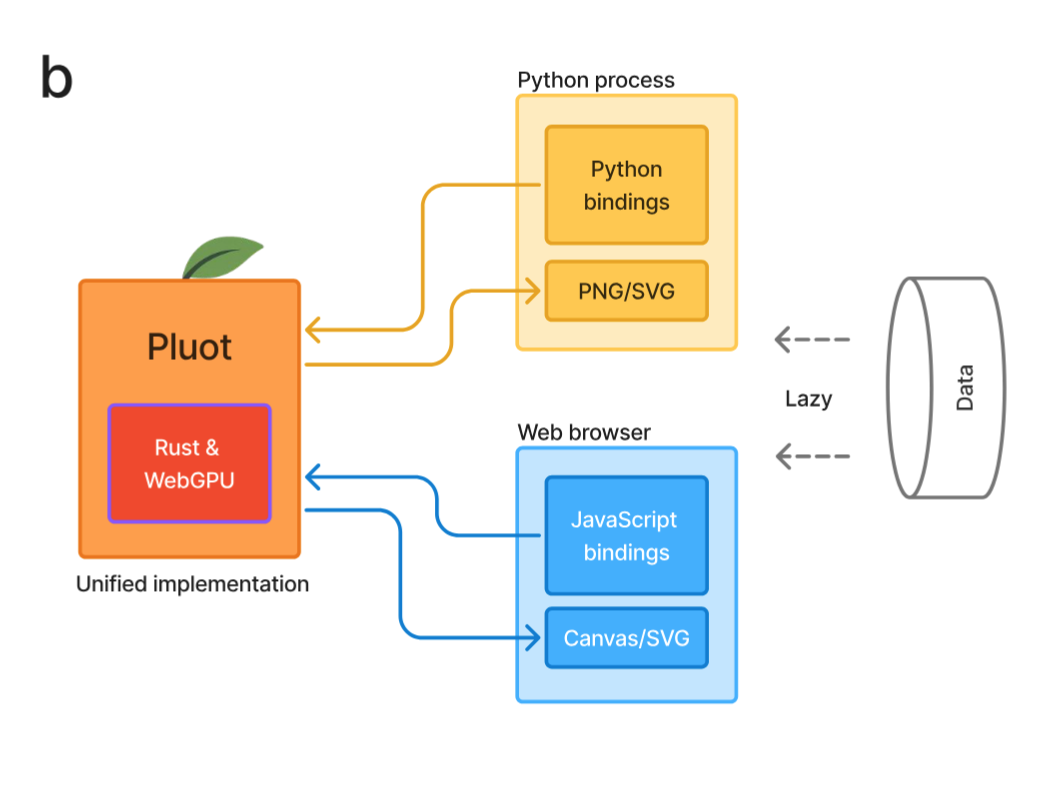
Tools used for implementing visualization software systems can generally be divided into camps such as static versus interactive and desktop versus web-based. We contribute Pluot, an architecture that bridges these divides, enabling a single software implementation of a visualization to be used regardless of the target level of interactivity or computing environment. With Pluot, a visualization developer implements a given visualization rendering function once, using the Rust programming language. Then, bindings to the Rust program can be generated to enable reproducible execution of the rendering function from other languages, such as Python or JavaScript. Pluot can render visualizations to bitmap or vector graphics format, bridging gaps between interactive performance and publication-quality figure creation. The software is available at https://pluot.dev.
Citation
MS Keller and N Gehlenborg. “Pluot: Towards ‘write once, run everywhere’ visualization software”, arXiv (2026). doi:10.48550/arXiv.2605.14118